Adsense

Showing posts with label annapurnacircuit. Show all posts

Wednesday, August 4, 2021

TREKKERS STRENGTH WORKOUT FOR ENDURANCE - "Fit To Trek@50 Series".


TREKKERS STRENGTH WORKOUT FOR ENDURANCE - "Fit To Trek@50 Series".


Muscular endurance is incredibly vital for a trekker or hiker to develop. It is one of the most specific elements of fitness, which can help a trekker / hiker to trek or hike comfortably all day long on different terrains. 


Endurance activity keeps your heart, lungs and circulatory healthy and improves your overall fitness. As a result, people who get the recommended regular physical activity can reduce the risk of many diseases such as diabetes, heart disease and stroke.


Muscular strength and endurance are important for many reasons - increase your ability to do activities like trekking, hiking, climbing, lifting boxes or chopping wood without getting tired. Also, reduce the risk of injury and help you keep healthy body weight.


The objective is to increase strength in major muscles that trekkers rely upon. Stronger legs and core muscles will better support the load in your back-pack and help you trek harder, longer. One need to build endurance in those same muscle groups , as well as the shoulders and lower back, because trekking can be an all-day activity.


The most common advice is you just train for trekking by going on a few treks. This definitely is something you should do, but if you are just getting into hiking or you aspire to do longer treks to places with high altitude, then doing some preseason training can be a big help.


This workout plan is designed to target areas that power you up the trail mile after mile. It will increase strength in your core and major leg muscles, and it will help to build endurance in those same muscle groups.


How A Trekker To Train For Endurance :

1. Increase strength in major muscles that trekkers rely upon. Stronger legs and core muscles will better support the load in your backpack and help you trek harder & longer.

2. Build endurance in those same muscle groups, as well as the shoulders and lower back, because trekking can be an whole day activity.

3. Improve your balance so you have a more stable base that will allow you to take uneven terrain in stride.

4. Do not forget your cardio. Complement this exercise routine  like trail running, mountain biking or another aerobic exercise that you enjoy.


TREKKERS STRENGTH WORKOUT FOR ENDURANCE :


This is a 10 minutes routine which you can do at your home, teaches you to be attentive to the way you move. You can of course, do the reps faster for HIIT workout, but I find that working slower and working on "time under tension" to be far more beneficial in building body weight strength and endurance , which is our current goal as we are training for mountain treks.


Each of these exercises will be for 45 seconds, with 15 seconds of rest in between two exercises.


1. Gentle Deep Body Weight Squat - 


This is for your lower body, including your quads, hamstrings, glutes, core, this is basically a compound exercise.


Here you have to do normal squats where you stand with both your feet about shoulder width apart and both your toes slightly pointing outwards. You have to slowly go deep as much as you can and then slowly come up, it has to be nice deep squat. You should go down and up with pressure on your both heels. You can put your both hands stretched forward and try to keep your upper body as straight as possible. You to inhale through your nose then slowly go down and exhale through your mouth only when you come up. This squat should be done very slowly while going down and coming up, not at the speed as you do during normal speed. The best way is to count 1 to 5 while going down & again count  1 to 5 while coming up. Always try to look in front while doing this exercise.

Do this for 45 seconds. 


2. Basic slow Push-ups -


This is for your upper body, including chest, arms, back and abs, basically this is a compound workout.


Here you have to do normal floor push-ups but at a much slower pace, go down with a count of 4 & push yourself up with a count of 4. Inhale through your nose and go down , exhale through your mouth only after you push yourself up. If you find floor push-ups difficult, then you can do inclined push-ups with your palms on a raised platform. If you want to make this challenging, then go for declined push-ups where you keep your toes on a raised platform.

Do this for 45 seconds.


3. Dead Bug - 


This is an exercise that connects your mind to your core. In this ab exercise you are not going to feel a burning sensation, but this type of connector is just as important for creating that deep core muscle strength. 


Here you have to lie face up with your arms extended towards the ceiling and your legs in a tabletop position with knees bent 90 degrees and stacked over your hips. This is a starting position. Then , slowly extend your right leg out straight, while simultaneously dropping your left arm overhead. Keep both a few inches from the ground. Keep your butt and core tight the entire time, with lower back pressed into the floor. Then bring your arm and leg back to the starting position. Repeat on the other side, extending your left leg and your right arm. Do this at a slow pace.

Do this for 45 seconds.


4. Deep Core Slash -


This is basically for your glute activation & outer leg muscles. Be on your side and begin with your knees and hips stacked, knees are slight forward from your body little bit with 90 degrees angle in both the knees , then press your elbow into the floor and push your shoulder blade into the ground and lifting up through your hips where you hold up for couple of seconds where you squeez and solidify the movement at the top, abducting the knee where your top knee is coming up and out to activate your glutes max along with few deep core muscles.

Do this for 45 seconds , where you will be able to go for about 12-15 reps.


5. Hollow Body Halt (For Beginners)- 


Lie don down on the floor on your back, then form a 90 degree angle on your knees and slightly lift your feet from the floor, then slowly lift your head and shoulders off the floor . Squeez your pelvis, flatten your lower back. Breath nice and deep slowly through your nose. Both your arms to be on your sides, palms facing upwards and both hands to be off the ground. This is an excellent exercise for your core.

Maintain this position for 45 seconds.


6. Single Leg Glute Lift - 


Lie on the ground on your back, fold both your knees, both your arms stretched out to your sides on the floor. Then lift your one leg straight up towards the ceiling, push the floor with the heel of your leg which is on the floor and lift your hips up as in glute bridge. Then again bring your hips down and repeat. Then change to the other leg by lifting it up and straight towards the ceiling. Excellent exercise for your core, especially lower back.

Do this for 45 seconds with each leg up. 


7. Down Dog Pedal - 


This exercise is basically a calf & hamstring stretch routine. Be on the floor with your knees and palms on the floor, like in "Cat-Cow pose", then lift your knees from the floor, so that only your feet (toes) and palms are on the floor. Then slowly try to push the heel of on leg towards the floor and feel the stretch on the calf of that leg. Then lift the heel and do the same with the other leg, go on doing this alternatively.

Do this for 45 seconds.


8. Bent Over Shoulder Rotations -


Stand on the floor, bend your upper body forward parallel to the ground with flat back, slightly bend your knees, stretch both your arms outwards and first rotate both the arms clock wise from your shoulder blades keeping your thumbs up. Then rotate your arms on anti-clock direction.

Rotate your arms clock wise 10 times and anti clock wise 10 times, it will take about 45 seconds.


You can, of course, do the reps faster for a HIIT workout, but  I find that slower and working on "time under tension" to be far more beneficial in building body-weight strength and endurance, which should be your goal when training for a TREK


IMPORTANT : 

💪 It is always advisable to consult your doctor / a qualified instructor before starting any new exercise routine. 

💪Take 12-15 seconds of rest between each exercise. Can sip water in between exercises.


Your valued comments, questions & suggestions in the comment section below, about this blog will be highly appreciated.


Do FOLLOW my BLOG PAGE for latest updates on FITNESS.


- My Facebook Page :        @fitnessfun50

- My YouTube channel :       fitnessfun50

- Follow me on TWITTER :  @ParthaD44328477

- Instagram :                         fitnessfun.50

- e-mail :                               partha63.pd@gmail.com


Friday, June 18, 2021

BEST CARDIO EXERCISES FOR MOUNTAIN TREKKERS - "FIT TO TREK@50" SERIES.


BEST CARDIO EXERCISES FOR  MOUNTAIN TREKKERS - "FIT TO TREK@50" SERIES.


You need not turn yourself into a rugged body builder with well defined bulging muscles to get into trekking. You just have to consider trekking as simply taking a longer walk in nature at any pace, at any altitude, and for any number of Kilometres, hours, or days. Always remember, how complicated or difficult or easy your trail is, every trek has it's perks. The more challenging the trek, the more calories you will burn along with more melting of your stress. 


As you TREK , your heart pumps in a nice and relaxed manner, circulating oxygen-rich blood throughout your body. When your body is receiving this vital oxygen-rich blood & nutrients your body and tissues stay younger & healthier with improved immune system. The TREKKING benefits are infinite.


A 3-5 hours of TREK in a day can boost your metabolism for up to 12 hours after the trek ! Paring a healthy balanced diet with a trek can help you lose some amount of weight without even doing much exercise. Additional benefits of trekking include strengthening your bones & improving your attention & memory. When WALKING in nature, research has shown 20% increase in attention & memorySunshine provides VITAMIN D , breathing PURE AIR calms nervous system, the different COLOURS OF NATURE - GREEN walking or FOREST bathing (Nature Walking) is phenomenally  good for our overall physical & mental heath. 


It should be made a routine to at least go for a MODERATE / MID-ALTITUDE TREKKING for minimum 10-15 days in a year, considering the missing nature in most of our city life. 


In most of the treks you will get rough terrains where at times you will be walking up a hill or mountain, then again descend, a combination which is a great workout for your legs and core area. Trekking up a mountain is like climbing stairs, which activates and strengthens your glutes, hamstrings, quads and calves. Whereas, trekking downhill activates your glutes and quads , as these muscles need to do a lot of slow, controlled work to stabilise your knees and hips so that you do not tumble down. These types of contractions damage muscle fibres the most, as you are resisting the force of gravity against your weight. In my previous two blogs have discussed in details about the exercises to strengthen your lower and upper body muscles.


Today, we will discuss about the next important activity after strength training, that is also a must when preparing for a trek - CARDIO VASCULAR ROUTINE. These activities not only boosts your confidence level, but also make you enjoy the trek.


This CARDIO workout will be just a 3 minute routine that you can do from the comfort of your home. The thing about cardio is - more does not always mean better. Long duration cardio puts stress on your body after a period of time. Long duration cardio produces a hormone called CORTISOL & the more cortisol your body produces, the less TESTOSTERONE is being produced, which will directly hamper to your trekking efficiency.


BENEFITS OF CARDIO EXERCISES :


1) Decreases -

a) Daily Fatigue,

b) Anxiety,

c) Depression,

d) Coronary artery disease,

e) Hypertension,

f) Obesity, etc.


2) Increases -

a) Body Flexibility,

b) Work, recreational & sports performance,

c) Sense of well-being,

d) Blood Lipid profile,

e) Insulin sensitivity,

f) Glucose tolerance,

g) Immunity, etc.


A cardiovascular activity makes your heart strong, improves the circulatory system in the body , and enhances your lung capacity. When you go for high altitude trek , your body requires more oxygen inhalation for which you need to have lung with more capacity to inhale oxygen. The circulatory system helps in supplying more oxygen and nutrients to your muscles from time to time. As trekking itself is a high intensity cardiovascular activity where you have to trek for about 4-6 hours doing assents and descends at various terrain levels, therefore it is very much necessary to have a strong heart condition.


CARDIOVASCULAR ROUTINE :


Jogging is the best cardiovascular exercise, as it is very much closely related to trekking, where your knees and ankle movement increases, and their surrounding muscles get strengthened, this same movements get repeated during trekking. You should start your jogging at least 3-4 months before your trek starts, as a preparation. 


Your benchmark for jogging should be to cover 5 kilometres in 35-40 minutes.  Initially this number may look impossible for you, for your benefit let me break down the schedule - the day you start your preparation, start jogging just as per your capacity, may it be even 100-200 metres, but daily after the run note down the distance covered and time taken on that day. Now, daily try to increase the challenge gradually and you will see that within next 35-40 days you will be able to achieve your target of 5 km in 35-40 minutes. 


Keep in mind that during this preparation time, you should never over stress yourself, always move ahead gradually as per your capacity. This jogging routine you can do on three to four days in a week, with a rest day in between.


In case you are not in a position to go for a jog thrice or four times a week, then you can mix your jogging with alternative home cardio exercises which will consume just 3 minutes of your time. Here you can do jogging say on two days of a week and twice a week do the cardio exercises. Avoid doing Jogging and cardio home exercises on the same day. It is always better to go for such a mix.


BEST CARDIO EXERCISES FOR  MOUNTAIN TREKKERS - "FIT TO TREK@50" SERIES.


CARDIO DURATION :


I have mentioned 5 cardio exercises, which will activate all major muscles and joints of your body in just about 3 minutes. Each of these cardio exercises is to be done for 30 seconds, with a 10 seconds rest between exercises. Beginners or those in their 50's or above , and are not in any kind of fitness routine can start with 10-15 seconds doing each exercise , and take 20 seconds rest between exercises.


If me at the age of 58 can go for it and do it, then why not YOU ? 

LIFE should NOT slow down after 50, rather should accelerate on top gear.


In this 3 minute cardio home routine you will notice that you will be made to go up or stand  and then back again on the floor to increase the intensity of this short duration cardio routine. 


If you want to make this cardio routine even more challenging, then after completing these 5 exercises take 15 seconds of rest, and then repeat the 5 exercises once more. Once you progress, you can do these 5 exercises just one after the other (back-to-back) without any rest in between the exercises, then take 20 seconds rest , and then again repeat these 5 cardio exercises back-to-back. Maximum you can do 3 such circuits with 20 seconds of rest in between each circuit.


CARDIOVASCULAR HOME EXERCISES :


1) Jumping jacks -


This is a total body exercise targeting major muscle groups and improves cardiovascular fitness and heart condition. This workout is a combination of aerobic exercise and resistance work. Jumping jacks activates your glutes, quadriceps and hip flexors. It also involve your abdominal and shoulder muscles. This workout makes your movement more explosive, gaining more strength and agility for TREKKING that require multidirectional movement.


As with most exercises, in this workout also, there is risk of injury in the lower body joints like knee and ankle. So, it is advisable to first start out with a base level of strength and conditioning routine. But, most people can safely do this workout.


How to do : stand up straight with your legs together and your arms down at your side. Then bend your knees slightly and jump. As you jump , spread legs to about shoulder-width apart and stretch your arms out and over your head, so they almost clap together. Jump again and return your arms and legs to the starting position.


Make sure you are performing this workout on a flat, even surface. Wear supportive, athletic shoes, and listen to your body, and stop if you experience any sort of pain.


2) Burpees / Floor Push-ups -


Floor Push-up


this is a full body exercise which works on most major muscle groups, improves cardiovascular fitness, enhances your body balance and coordination. Burpees improves your strength and mobility. This workout is excellent to keep you TREK FIT.


How to do : this is a 4 point move. Stand straight, then drop into a squat with your hands on the ground just in front of your feet. Then kick your feet back behind you, keeping your arms extended so you are in a raised plank position., from here you can either go for a floor push-up, or from plank position jump to your feet back towards your hands, then leap into the air with your arms straight  above you. Then do it all again.


Initially, if you find doing burpees difficult, then can do just normal floor push-ups .


3) Squat jump -


Jump squats increase your explosive power, improve upper and lower body strength, and burn calories faster . This also improves flexibility in your ankles and hips, also this exercise helps prevention of  injuries during other exercise routine and TREKKING.


How to do -  stand straight with your feet hip-width apart. Hinge at the hips to push your butt back and lower down until your thighs are parallel to the floor. Then press your feet down to explode off the floor and jump as high as you can. Allow your knees to bend 45 degrees when you land, and then immediately drop back down into a squat, and jump again.


4) Mountain climber - 


This exercise targets your full body, but especially your arms, shoulders, quads  and core. This workout raises your heart rate. Mountain climbers builds cardio endurance, core strength, and agility. Several muscle groups are activated by this exercise.


Your shoulders, arms, and chest work to stabilize your upper body while your core stabilizes the rest of your body. As the prime mover, your quads get an incredible workout too. As this is also a cardio exercise, you will get heart health benefits and burn calories. So, overall this is a very effective exercise when preparing for a Mountain TREK.


How to do - get in a plank position, with even distribution of your body weight between your toes and hand. Your hands should be about shoulder width apart, back flat, abs engaged, and head in alignment. Then pull your right knee towards your chest as close as possible. Switch legs, pulling one knee out and bringing the other knee in. Keep your hips down, run your knees in and out as far and as fast as you can. Alternate  inhaling and exhaling with each leg change. Never hold your breath.


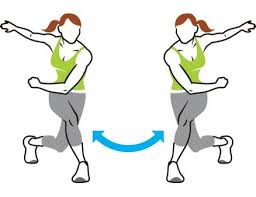
5) Skaters -


 these are a great cardio exercise involving jumping in a pattern that shifts your body weight  from side to side to create a skating stride. Though it mainly increases leg power, it is considered a full body , dynamic workout as it also targets your glutes medius and adductors of hip joints. Thus, making you ready for a mountain TREK.


How to do - stand with your legs hip width apart, bend one leg behind the supporting leg at a slight angle, while maintaining weight and balance on the supporting leg. As you exhale, simultaneously swing your arms out and leap over to the opposite side. Shift your weight and land with the opposite leg behind you. Be sure to land on the ball of your foot with your hips and knees bent slightly. 


IMPORTANT : 

💪 It is always advisable to consult your doctor before starting any new workout routine. 

💪To keep your body hydrated you may sip water as and when required during workout.

💪Take 10-15 seconds of rest between each exercise.


Your valued comments, questions & suggestions in the comment section below, about this blog will be highly appreciated.


Do FOLLOW my BLOG PAGE for latest updates on FITNESS.


- My Facebook Page :        @fitnessfun50

- My YouTube channel :       fitnessfun50

- Follow me on TWITTER :  @ParthaD44328477

- Instagram :                         fitnessfun.50

- e-mail :                               partha63.pd@gmail.com