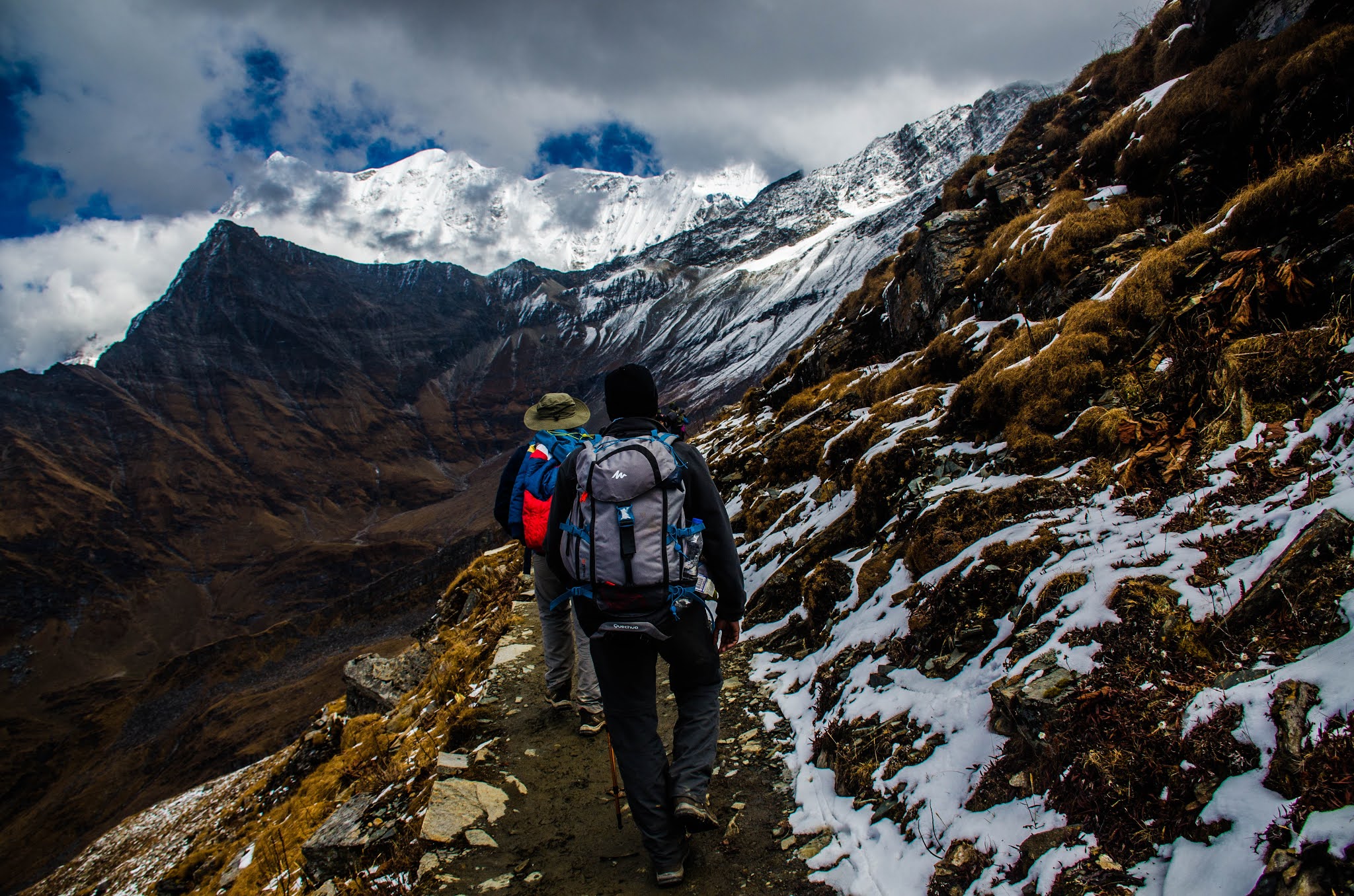
HOW TO IMPROVE YOUR LUNG CAPACITY FOR HIGH ALTITUDE TREKS
Let us look at the basics to understand why breathing is important for a high altitude trek. Breath is a barometer for the nervous system . As the nervous system becomes imbalanced, breathing changes, becoming shallow, tense, and jerky. This change is then registered by the mind and begins to create internal distress, which sustains poor breathing, which promotes a state of distress. In this way, an internal cycle begins and is reinforced. Stress then takes on a life of its own, even persisting after the original stressor has been resolved. Learning to breath correctly with awareness is the only way to break this powerful cycle.
When you breath in, your heart's beat is up, when you breath out it slows down. Body is so incredibly intelligent - when you breath in there is more oxygen in the lungs , so the body speeds up the heart rate to send more blood there to pickup the oxygen because that is more efficient . When you breath out there is less oxygen, so we slow down the heart rate, not wasting resources.
When there is coherence in your nervous system between your brain & your heart then your heart rate variability is going to be coherent , it will form a smooth pattern. If you measure your average heart rate at 65 beats , then if you have a healthy heart variability it means when you breath in then your heart rate is 70 & when you breath out it is 60, this turns out to be the best indicators of overall health that we know of. People who are not healthy have an incoherent pattern , when you are frustrated, angry then there is just no pattern , every heart beat is sort of chaotic and mismatched.
Considering the general health condition of a considerable portion of world population especially those living in cities , irrespective of their age, people in some way or the other get easily effected by change of season , pollution , various type of viruses / infections , become allergy prone with frequent cough & cold issues, have respiratory problem & get into other health issues, mainly due to poor IMMUNE SYSTEM .
Longevity of Life is measured by Breaths Per Minute:
Normally the way we breath is just surface breathing , the Yogic way is much different. In surface breathing , that we all do, average respiratory rate of an adult is between 12 - 18 breaths per minute . Where as among mammals, a whale which has the most efficient respiratory system they normally hold breath for 80-90 minutes , the beaked whale can hold for 2 hours . The average life span of a human is 79 years , whereas the average life span of a whale is 90 years , some bowhead whales have lived even more than 200 years.
In Yogic way of breathing , the breaths per minutes are reduced to an average of 6-10, thus some of the Yogis could increase their life span to 150 years and much more , as per their need.
The rate of breathing can be up to 60 times a minute at birth. This then falls to 12-16 times during adolescence and remains that through life. In the process of breathing , we take in air containing 20 percent oxygen. The concentration falls to around 16 percent when it is exhaled.
Breathing is involuntary. Centres in the brain respond to changes in the oxygen and carbon dioxide levels in our blood. They send signals to the respiratory muscles.
In our modern society, many have lost the ability to breathe well. While breathing in, the abdomen should move out to increase the capacity of the chest and facilitate lung expansion, thus improving your lung capacity.
Often, people have shallow, rapid, inefficient breathing. As they breathe in, the abdomen also moves inwards, thereby decreasing the lung capacity. Efficient breathing means good air exchange.
Yoga teaches correct breathing techniques. These are the traditional
PRANAYAMA .
The word PRANAYAMA comprises of two words : PRANA + YAMA .
PRANA indicates Life Energy consisting of oxygen , various digestive energies or digestive fire and the Vayu that helps us to excrete (there are many more energies but basically Prana has been divided into 4 parts - Prana , Upana , Udana & Samana). Prana does not mean only the air we breath (Swasa), as we cannot directly touch the other energies , except by our SWASA , so we call this activity PRANAYAMA , or else it would have been named SWASAYAMA.
YAMA means rules & regulations.
So, we can confer that PRANAYAMA means - the rules and regulations related to manipulation and controlling our breathing rhythm / process / technique for improved functioning of our various Energies. It would be enough for us to just understand that PRANAYAMA basically means breathing in more OXYGEN in to our LUNGS , or increase our LUNG capacity. Please note that during performing of any PRANAYAMA, always keep your Palm/Palms facing upwards as this facilitates flow of more Air into our Lungs.
Breathing exercises are important for number of reasons - it changes the PH of our body, it help reduce stress, depression, it help rib alignment which is most important as no one exercises their rib muscles that is the internal and external intercostal muscles. These are many different muscle groups that run between the ribs, and help form and move chest wall. The intercostal muscles are mainly involved in the mechanical aspect of breathing by helping expand and shrink the size of the chest cavity, thus determine the capacity of the lung to expand.
Aerobic exercises along with few breathing exercises will improve your VO2 max - the maximum volume of oxygen that your body can use. This is important for a HIGH ALTITUDE TREK as there will be less oxygen in the air for you to consume and breath has to count.
Before heading out to trek on a 5000-6000 meter mountain trail, it is important to know proper breathing techniques in order to cope with the thin air and freezing temperatures. There are many different types of breathing techniques aimed at achieving all sorts of goals, many stem from ancient breathing techniques such as Pranayama.
Prior to heading on any high-altitude mountain trekking, it is best to add some breathing exercises to your normal training routine. At high altitudes, the air is colder, less dense and contains a lower concentration of oxygen molecules relative to carbon dioxide.
We can term an altitude of about :
🗻 2500-3600 meters - as high altitude,
🗻 3700-5500 meters - as very high altitude, &
🗻 above 5500 meters - as extremely high altitude.
Proper preparing to head into this type of environment will greatly increase your chances of success and enjoyment in your trek.
When you are at sea level, about one-fifth of the air that you breathe in is oxygen and the air pressure is about 760 mmHg. As the altitude increases, pressure decreases and the air becomes thinner. Higher pressure at sea level keeps oxygen molecules compressed together in air, so it is easier for us to breathe the amount we need in just one breath. As you go to higher altitudes, the molecules spread out and in the same single breath there are fewer oxygen molecules and so you need to work much harder to get the same amount of oxygen.
If you ever trek above 3000 metres, then you would have had over a third less oxygen in each of your breaths, as compared to sea level.
You will feel the effects of altitude on your body at altitude on your body at altitudes as low as 2500 meters and will steadily be able to advance to higher altitudes with proper acclimatisation, which a good guide will lead you through.
Therefore, before heading for a high altitude trek, it is important to know proper breathing techniques in order to cope with the thin air and freezing temperatures.
Here, myself have suggested few of the breathing techniques, that will help you to improve your lung capacity and thus make you able to inhale more oxygen during your high altitude treks.
1) BELLY BREATHING (Vasistha Pranayam) :
Also known as diaphragmatic breathing or abdominal breathing. It facilitates a full oxygen exchange and can be easily done at the comfort of your home. In order to re-acclimate yourself to this type of inhalation, it takes some practice.
How to do - you have to lie down on your back on the floor, with bent knees, place both your arms to your side with palms facing upwards. Now slowly inhale through your nose and instead of taking the air towards your chest , take it towards your stomach, in a way that your belly bulges like a balloon. Doing this you may feel a bit strange at first, that is because you are using your entire lung capacity to breathe. This allows more oxygen to be pumped through the body, particularly to your extremities, and prevents the buildup of cramp-causing lactic acids. Then slowly exhale through your nose while pressing your belly in.
Practice this daily for about 5-10 minutes, until it becomes natural, especially before undertaking a trek.
2) THE PRESSURE BREATH :
Once you have mastered the belly breath, start practice of this breathing technique. Here you can sit on the floor with crossed legs or sit on a chair with your back comfortably erect , your body should be relaxed, both palms facing upwards placed on your knees,or can place one hand on your stomach, now do inhalation process similar to the inhalation technique in BELLY BREATHING, but while exhaling you can add resistance to your exhalation by pursing your lips and exhaling forcefully. This is one of the most important breaths for trekking at high altitudes, as this helps to combat the decrease in atmospheric pressure.
Practice this daily for about 5-10 minutes, especially before undertaking a trek.
3) BREATH HOLDING TECHNIQUE :
This is another technique that can help you cope with high altitude. One of the best ways to prepare your body for this type of high altitude treks is through simple breathing exercises, that should be practiced with appropriate caution.
How to do - sit on the floor with legs crossed, your back should be comfortably erect, body in relaxed mode, both palms on your knees facing upwards. Then slowly start inhaling deeply through your nose to your maximum capacity (with the count of 4-6), then hold your breath for the count of 3-6 initially, and as you progress can hold to the count of 6-8, but should never forcefully hold your breath. Then slowly exhale through your nose to the count of 4-6, slowly increase the counts as you progress.
The ideal count for inhalation-hold-exhalation should be in the ratio 1:4:2, that is - if your inhalation count is 4, then hold count to be 16, and exhalation count to be 8. This you can do as you progress.
4) A POWERFUL BREATHING TECHNIQUE :
This technique is considered one of the most powerful breathing technique which not only increases your lung capacity, but also improves your immune system.
How to do - ensure that your stomach is not too full, you must be some what hungry , even if you are not totally empty stomach. You have to sit in a cross legged posture whichever way you can, what ever your body permits and then use both the arms to push it up in such a way that your rib cage lifts off the diaphragm region fully pushed up, and now you have to fully stretch your tongue out with your mouth fully open and then breath as powerfully as possible without jerking the abdomen , but powerful pushing in and pushing out both INHALATION & EXHALATION 21 times, and when it is done then you role up your tongue upward, push it as further back you can , do not use your hands, and still with your mouth open again breath the same way - INHALATION & EXHALATION as powerfully as possible, but must get the sound by making a constriction in your throat (see demo video). The sound must be there, it is important that you form a constriction at throat , at the pit of the throat & make the sound fully inhaling & fully exhaling as powerfully as you can, but without jerking the abdomen another 21 times with tongue rolled up.
After this is done , then close your mouth & INHALE fully through your nose and simply sit there with the fullness of breath for 60 seconds, then exhale through your nose with your mouth closed making a sound at the pit of the throat by creating a constriction and then sit quietly for sometime with your eyes closed & do normal breathing, then you can do your normal work.
If you are beyond a certain age or your breathing is not that good then hold breath for at least 30 seconds. If you are not able to do 60 seconds, a minimum of 30 seconds you stay there. When the day you are not being able to do it you must understand there is some problem with your respiratory system & you must go for a check up.
5) Slow Deep Breathing with light Weight Dumbbells: This is another excellent breathing exercise which expands your rib cage & increases your lung capacity..
Take 2 light weight dumbbells (about 1 kg or 500 ml. / 750 ml. filled water bottles) as per your capacity in both your hands, bring both your arms sideways in line of your shoulders,with your wrists facing front, bend your arms in a way that both the dumbbells are in line with your chin (as shown in pic above), then inhaling very slowly and gently raise both your arms just above your head, but do not straighten your arms above your head, hold your arms & your breath in that position for about 3-5 seconds, and then slowly bring both your arms down to the starting position while gently effortlessly exhaling with no noise. Always keep in mind to maintain a very slow rhythm.
6) HUMMING BEE TECHNIQUE (Bhramari) : Doing a BHRAMARI Pranayam before start of meditation helps in mental calmness. This Pranayama also known as ad Humming Bee Breath, is a calming breathing practice that soothes the nervous system and helps to connect us our truest inner nature.
How to do - Sit in a cross-legged position, close your eyes and breath deeply.Now close your ears with your thumbs, place your index finger just above your eyebrows and the rest of your fingers over your eyes, with your middle fingers of both hands apply very gentle pressure to the sides of your nose. Now concentrate your mind on the area between your eyebrows. Keep your mouth closed , breath out slowly through your nose with making a humming sound of "AAOOMMMMMMM". Repeat this process for 5 times. Important thing is that while doing this PRANAYAMA assume that you are being connected to all the positive energies of the cosmos.
In addition, BHRAMARI or humming bee breathing technique increases nitric oxide concentration and exhalation of carbon dioxide. It makes the blood more alkaline and reduces coagulation, heart attacks,stroke and ventilator dependency in COVID-19.
7) Maha Sambhavi Mudra : when you are trekking on high altitudes, especially on the HIMALAYAS, always remember, this mountain range had been and even is a meditation ground for many great saints living or in the past. These enlightened souls created and left behind certain level of energies around their area of meditation, these very positive energies are live and vibrant even after ages these holy beings moved over to the other dimension.
If you are regularly practicing certain kinds of pranayama and meditation techniques, then your receptiveness to such positive energies enhances when you trek on such terrains. Maha Sambhavi Mudra is one of such technique.


How to do - Sit in a cross-legged position, your back should be comfortably straight, whole body to be lose , with palms on your knees facing upwards in Gyana / Vishnu Mudra (where in both hands, the tip of your index finger touches the tip of your thumb forming a ring 👌). Then slightly raise your head upwards, focus both your eyes at a centre point between your both eyebrows (gazing point) & close your eyes, then slowly inhale (count of 6-8) & exhale (count of 8-10) through your nostrils, this should be very smooth and with no sound. You should fully concentrate on the air going in & going out , in other words fully concentrate on your inhalation and exhalation, so that your mind do not get engaged in some other thoughts. Maha Sambhavi Mudra is said to be one of the ideal posture for meditating.
Regular practice of the above breathing techniques will improve your lung capacity and thus you will be able to inhale more OXYGEN during your high altitude treks. If you are not getting enough oxygen, your muscles can not work as efficiently and you might feel tired, experience muscle cramps or even get dizzy.
TREKKING at HIGH ALTITUDES, proper breathing can make the difference between a leisurely hike and a dangerous TREK.
IMPORTANT :
💪 It is always advisable to consult your doctor / a qualified yoga instructor before starting any new exercise routine.
💪Take 10-12 seconds of rest between each exercise.
Your valued comments, questions & suggestions in the comment section below, about this blog will be highly appreciated.
Do FOLLOW my BLOG PAGE for latest updates on FITNESS.
- My Facebook Page : @fitnessfun50
- My YouTube channel : fitnessfun50
- Follow me on TWITTER : @ParthaD44328477
- Instagram : fitnessfun.50
- e-mail : partha63.pd@gmail.com